
Salesforce-native relationship mapping — built from data in your CRM.
"We have 12,000 contacts in Salesforce. Maybe 200 are mapped to actual influence."
RevOps lead, industrial services
"I keep my real account map in OneNote. Salesforce just has names."
KAM, manufacturing
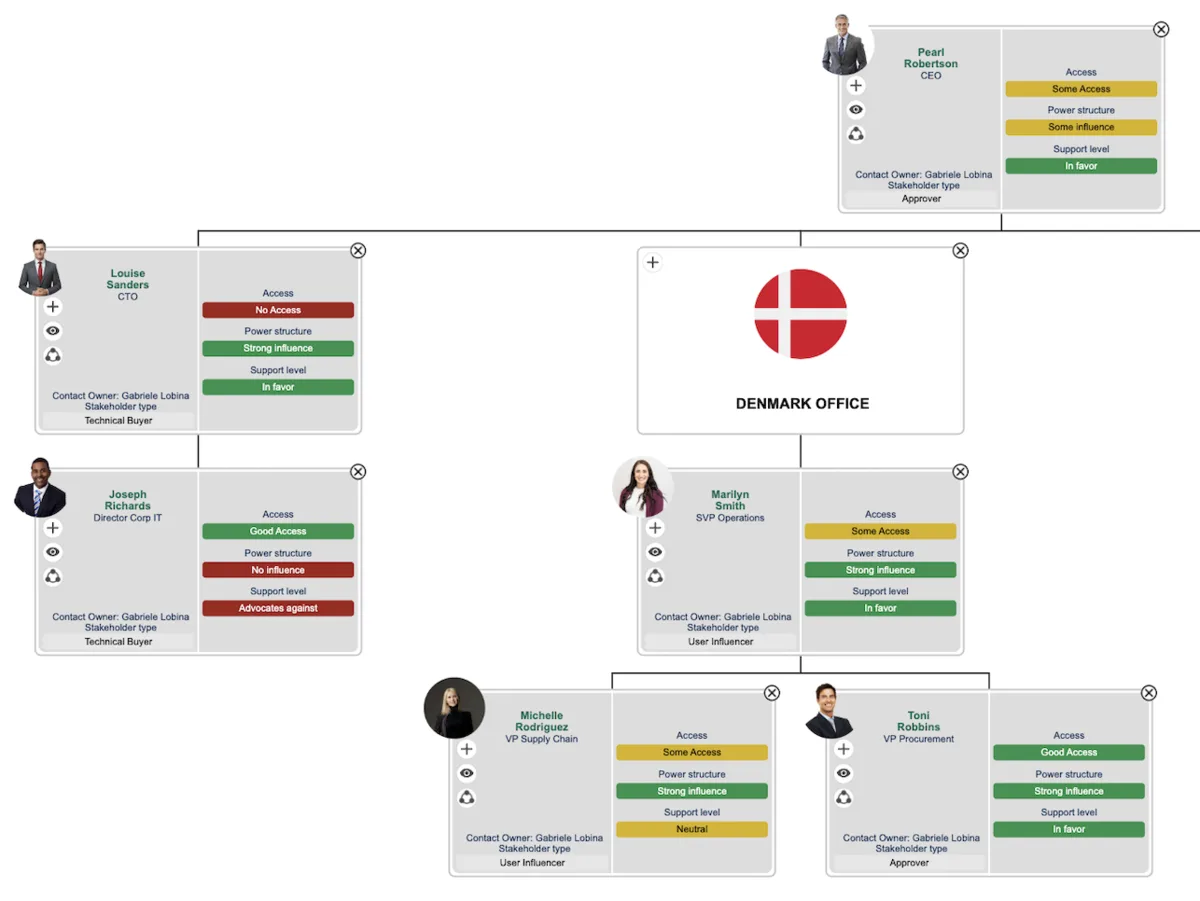
When a rep leaves an account, the relationship record stays in Salesforce. When a new rep joins, they inherit the prior team's stakeholder map, relationship assessments, and interaction history immediately — no re-discovery, no calls to former colleagues, no PowerPoint org charts to chase down.
An AI Agent auto-builds and maintains org charts from Salesforce contact records and email and call activity. No manual drag-and-drop. No third-party AI tax. The agent runs on Salesforce Agentforce as a Salesforce-native ISV extension — a $0 line item on your AI bill.
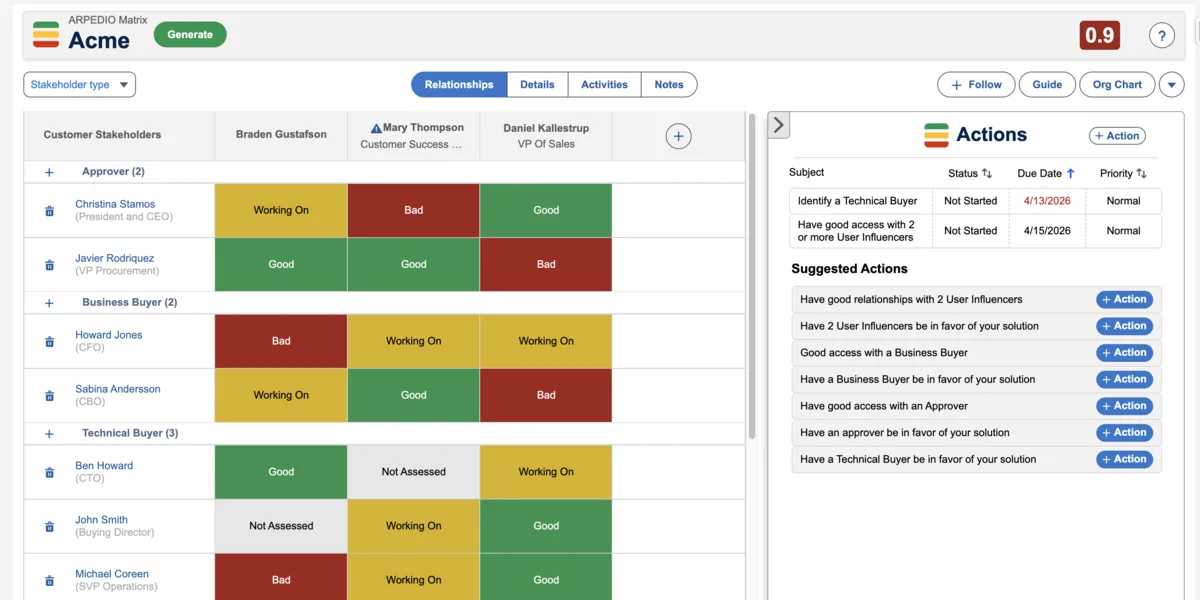
Stakeholder matrices score every contact on access, influence, and support — color-coded by relationship health and updated from interaction data. When a relationship weakens, the next-best-action surfaces in the matrix: "Two user influencers need to move to advocate status." Managers see the matrix at account level and at opportunity level.
Activity feeds, stakeholder notes, and meeting history all live on the contact record — visible to anyone on the account team. New reps scroll the timeline to understand what's happened; the notes thread answers "what does this stakeholder care about?" without a sidebar conversation. Salesforce becomes the source of truth, not a launchpad for shared inboxes.
Airbus's Centre of Excellence for Strategic Account Management defined a global KAM framework — methodology, three-stage development program, SAMA certification path. ARPEDIO is the Salesforce-native platform that operationalizes it. Account plans, stakeholder maps, and relationship assessments live in Salesforce, accessible to every KAM and KAM coach across the program.
The result: account knowledge no longer resets when contacts rotate or KAMs move on. The Centre of Excellence sees how the program is being applied at account level, in real time.
Read the Airbus story →Stakeholder mapping is the practice of identifying every person who can influence an enterprise sales decision — economic buyers, technical evaluators, user champions, blockers, coaches — and assessing each one's level of access, influence, and support. Done well, it's the operating system for strategic account work. Done in PowerPoint, it's a screenshot from a meeting that happened six months ago. ARPEDIO is built on the SAMA 7-step framework, so the maps your account teams build inside Salesforce match the methodology your KAMs are already trained on.
See the SAMA methodology partnership →Co-developed on the SAMA 7-step framework — the same methodology your strategic account managers are trained on, operationalized inside Salesforce.
Relationship Mapping sits inside the same Salesforce-native platform that covers opportunity qualification and strategic account planning. One data model, one security architecture, one source of truth.
Methodology-derived deal scoring and a leadership heat map that turns the weekly 1:1 into action.
Explore MEDDPICC →Stakeholder intelligence for enterprise accounts. AI-built org charts, relationship matrices, activity timelines.
Native Salesforce account plans, SWOT, and white-space analysis — multi-year governance for your most strategic accounts.
Explore Account Planning →AI-generated org charts from existing Salesforce contact and activity data — at zero flex-credit consumption.
See the Agents →An org chart shows reporting structure — who works for whom. A relationship map adds the layer enterprise sales actually runs on: who influences a decision, who blocks one, who supports your position, and how strong each relationship is. ARPEDIO builds both — the org chart is the structural skeleton; the relationship matrix tells your team where to focus.
Yes. ARPEDIO is co-developed with SAMA, and the relationship-mapping workflow follows the 7-step framework. SAMA-certified strategic account managers apply the methodology they were trained on directly inside Salesforce — same stages, same assessments, no re-learning.
Inside your Salesforce instance. Org charts, relationship matrices, and stakeholder notes are Salesforce records — your security model, your retention rules, your governance. Data never leaves Salesforce.
Yes. ARPEDIO reads contact records, account records, and activity data — including emails, calls, and meetings captured by Einstein Activity Capture. Richer activity data produces a more accurate AI-built org chart.
Yes. ARPEDIO is a managed package on AppExchange — it installs into your existing Salesforce instance with no data migration. The first AI-generated org chart pulls from contacts and activity already in Salesforce on day one.
Zero. ARPEDIO's org chart Agent is a Salesforce-native ISV extension on Agentforce — it doesn't consume Salesforce flex credits. There's no second AI tax to use it.
Salesforce holds contacts and activity data; it doesn't structure them as an org chart with influence and support assessments. Building that structure manually is one of the things sales teams say they should do but don't. ARPEDIO closes that gap — and the AI Agent removes the manual burden that kept it open.
That's exactly what the AI Agent solves. The org chart populates automatically from contact and activity data already in Salesforce. Reps don't have to enter the org chart for it to exist — they review it, refine it, and add the qualitative judgments only humans can make: who blocks, who advocates, who's coachable.
See ARPEDIO's relationship mapping running on Salesforce — a recorded 5–7 minute walkthrough, no form to fill in.