
MEDDPICC® assessment in Salesforce — every opportunity scored and surfaced in the heat map.
"A big deal blows up at the end of the quarter. Two weeks earlier, no one could tell you it was going to."
CRO, industrial technology
"Most of our reps have heard of MEDDPICC. Fewer actually run it. Almost nobody runs it the same way as the rep next to them."
Head of Sales Transformation, manufacturing
Eight MEDDPICC dimensions scored on every opportunity — Metrics, Economic Buyer, Decision Criteria, Decision Process, Paper Process, Identified Pain, Champion, Competition. ARPEDIO converts the structured rep input into a 0–5 opportunity score with traffic-light status per dimension. Managers see exactly which qualification gaps are closing and which are stuck. Reps see what to work on next, not a blank rubric.
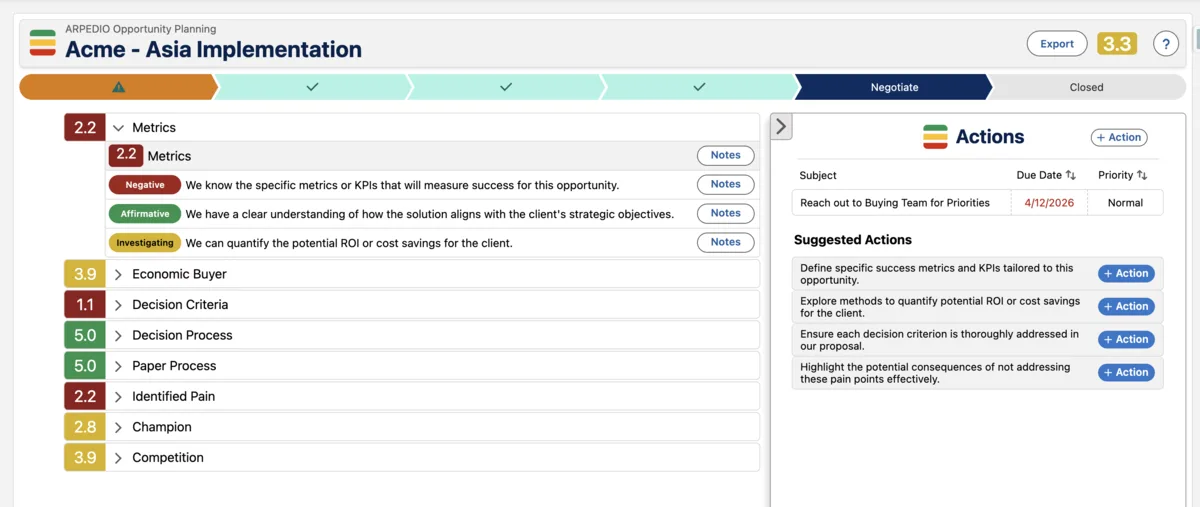
Salesforce's stage-based probability stays in place — finance and operations read it the same way they always have. ARPEDIO runs a second probability alongside it, derived from the MEDDPICC assessment. When the two converge, the forecast is credible. When they diverge, the divergence is the signal worth reviewing before the number rolls up to the board.
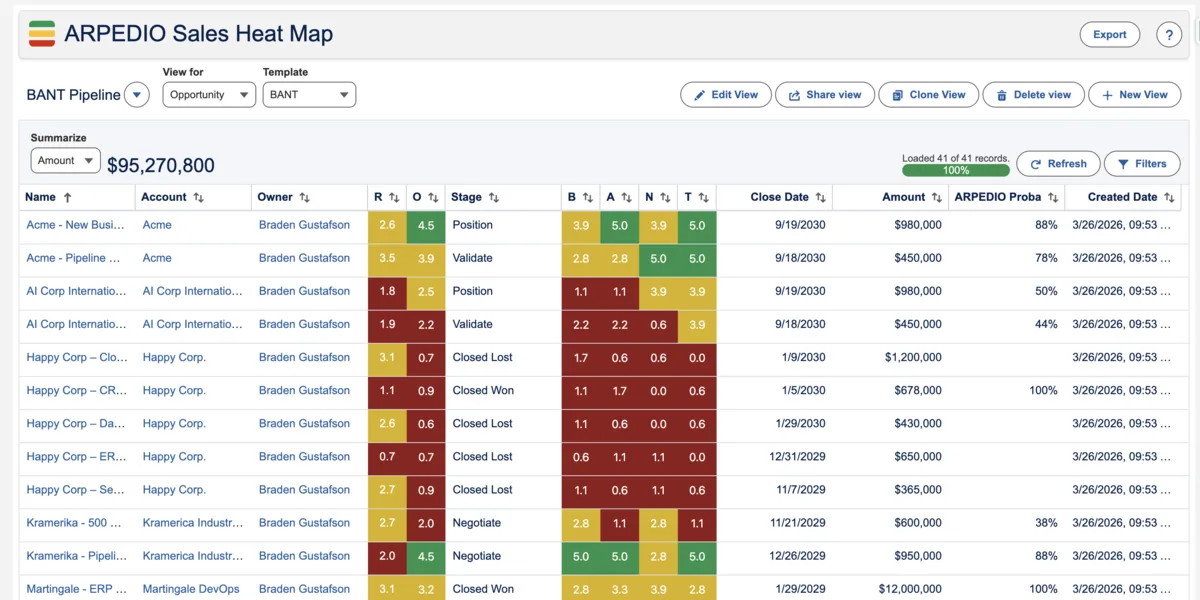
Every opportunity (or account) colour-coded on a single dashboard — green on track, yellow watchlist, red critical attention. Managers open ARPEDIO at the start of a 1:1 and never leave it during the conversation. Filters become the agenda. Drill into any row to open the MEDDPICC detail inline, editable without changing screens. Reps stop wondering which deals their manager will ask about.
Reps advance to Negotiation while MEDDPICC still reads Identified Problem. ARPEDIO surfaces the mismatch as a soft gate — coaching, not blocker. Reps can override; managers see the override. Stage-inflation surprises drop because the platform names them before they hit the forecast, and the conversation shifts from "why is this deal in Negotiation" to "what's needed to earn that stage."
Opportunity is in Negotiation but MEDDPICC assessment shows Identified Problem. Verify qualification before advancing.
"We went back, looked at the scores, and the account executive built a brand new plan based on the suggestions in ARPEDIO. He brought it to a strategic session, executed it flawlessly — and within three weeks, that deal closed. That's the power of ARPEDIO!"
WBM Technologies — a Canadian IT services firm selling complex, multi-stakeholder engagements — was already on Salesforce, but qualification ran on rep experience. A strong AE qualified well; a newer one guessed. The forecast inherited both.
WBM embedded ARPEDIO in the CRM and tuned the MEDDPICC scoring to their own methodology. Next-step guidance runs inline in the rep workflow; a custom Pipeline Estimate Calculator links scores to historical win rates. Opportunities scoring 4.4 or above close 98% of the time — a number finance can actually forecast off. The three-week close Ryan describes wasn't a lucky deal; it's what happens when the methodology surfaces the gap before the rep has to figure it out.
Read the WBM story →MEDDPICC is the qualification framework most enterprise B2B sales organizations use to pressure-test whether a deal is real. It grew out of PTC in the 1990s, was formalized by MEDDIC Academy, and spread through companies selling complex, multi-stakeholder deals. The eight components aren't a checklist — they're a structured conversation a rep has with the buying organization. ARPEDIO's job isn't to teach the methodology; it's to run it inside Salesforce — the scoring, the fields, the heat map, the coaching signals — so reps do the qualification work where they already sell.
Read the MEDDPICC implementation playbook →Eight dimensions every enterprise opportunity is scored against. Originated at PTC, formalized by MEDDIC Academy — the industry standard for complex B2B sales.
MEDDPICC assessment sits inside the same Salesforce-native platform that covers stakeholder intelligence and strategic account planning. One data model, one security architecture, one source of truth.
Methodology-derived deal scoring and a leadership heat map that turns the weekly 1:1 into action.
Stakeholder intelligence for enterprise accounts. AI-built org charts, relationship matrices, activity timelines.
Explore Relationship Mapping →Native Salesforce account plans, SWOT, and white-space analysis — multi-year governance for your most strategic accounts.
Explore Account Planning →AI-suggested next-best-actions based on your MEDDPICC assessment.
See the Agents →MEDDIC is the original six-part qualification framework — Metrics, Economic Buyer, Decision Criteria, Decision Process, Identify Pain, Champion. MEDDPICC adds two components: Paper Process (legal/procurement steps) and Competition. Both are supported in ARPEDIO. Teams already running MEDDIC keep running MEDDIC; teams modernizing adopt MEDDPICC. Mixed environments also work — the scoring engine adapts to whichever framework sits on the opportunity.
Yes. Scoring weights, per-field rubrics, and stage-gate thresholds are configurable per sales organization. ARPEDIO ships with a default MEDDPICC scoring model and lets admins tune weights to match how your team qualifies — for example, weighting Champion more heavily in enterprise deals than in mid-market. The methodology is the framework; the scoring is yours.
Empty fields show up explicitly on the opportunity and in the heat map — surfaced as gaps, not hidden as zero scores. Managers see who's filled what during 1:1 reviews, which is often enough to drive adoption. ARPEDIO's coaching layer also nudges reps in-workflow: if a deal moves to Negotiation with Champion still blank, the platform surfaces the gap before the stage change lands.
No. Custom fields hold data; they don't score it, surface gaps, or drive action. ARPEDIO adds four things on top of the fields: a scoring engine that converts qualitative rep input into a 0–5 score, a sales heat map that rolls scores up across the pipeline, a dual-probability display that compares MEDDPICC scoring against Salesforce stage, and coaching nudges that flag stage-vs-qualification mismatches. Fields alone won't change rep behavior — the scoring layer is what does.
The heat map is built for sales leadership views — hundreds of opportunities are the normal case, not the edge case. Filter by owner, segment, region, stage, score band, or relationship health. Drill into any row to open the MEDDPICC assessment inline without leaving the heat map. Managers typically open the heat map before a 1:1 and never leave it during the conversation — the filters become the agenda.
No. The Salesforce stage-based probability stays in place — it's what finance and operations are used to reading. ARPEDIO runs a second, methodology-derived probability alongside it. When the two converge, the forecast is credible. When they diverge, the divergence is the signal — a 70% stage probability paired with a 3.2/5 MEDDPICC score is a deal worth a second look before roll-up.
Yes. The scoring engine is methodology-agnostic. ARPEDIO ships MEDDPICC and MEDDIC as defaults because they're what most enterprise B2B teams qualify on, but Sandler, Challenger, and in-house frameworks are all supported. You define the fields, the rubric, and the weights; ARPEDIO handles scoring, rollup, and heat map visualization.
Inside your Salesforce instance. MEDDPICC fields, scores, heat map configuration, and forecast signals are Salesforce records — your security model, your retention rules, your governance. Data never leaves Salesforce.
See ARPEDIO's MEDDPICC assessment and sales heat map running on Salesforce — a recorded 5–7 minute walkthrough, no form to fill in.